
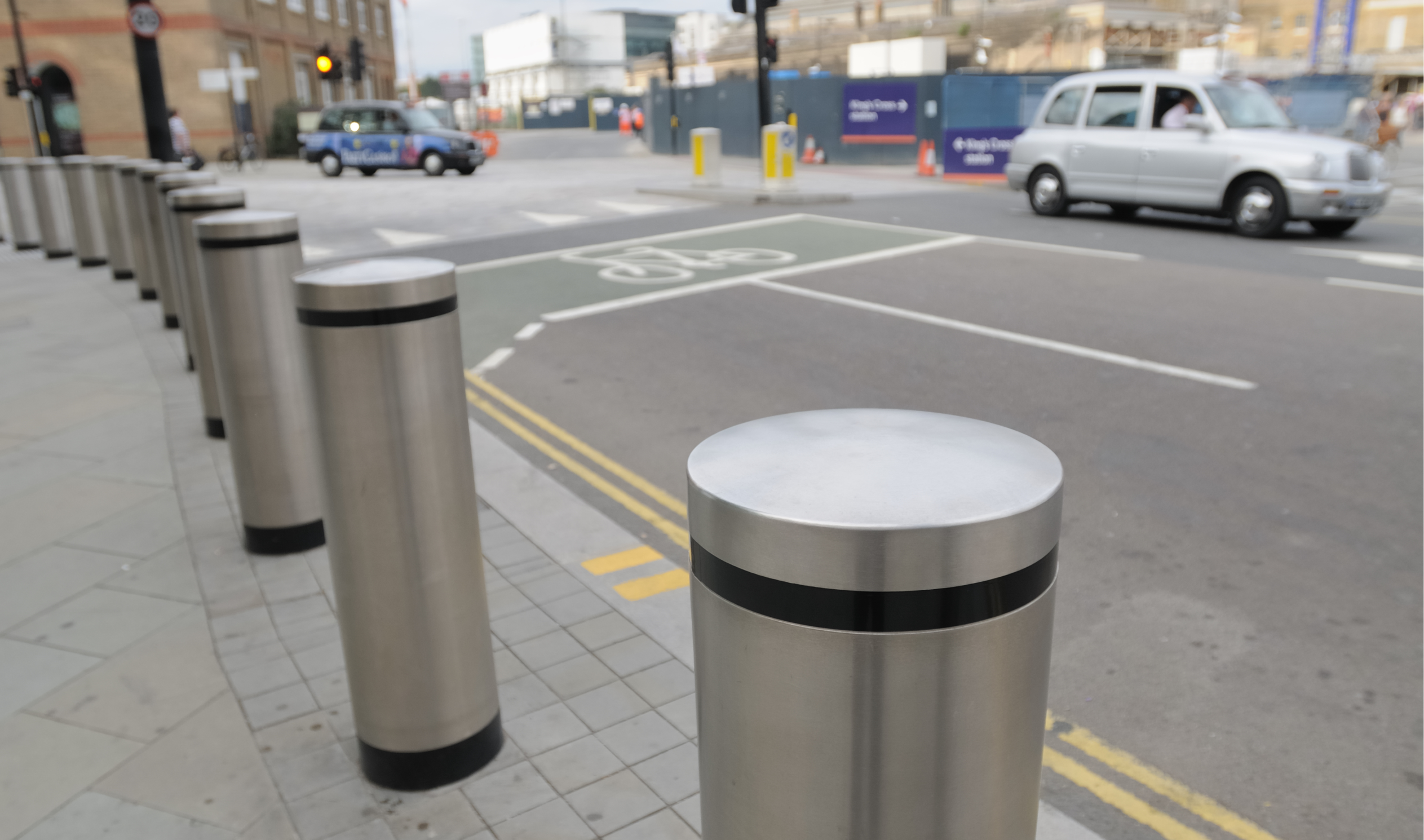
As cities grow denser, the interactions between pedestrians and vehicles increase, underscoring the urgent need for effective safety infrastructure. Yet, a fundamental question emerges as we install safety measures on our streets: who are we really protecting?
The Dilemma of a Zero-Sum Game
For decades, the design logic behind road bollards has appeared straightforward: use robust barriers to stop out-of-control vehicles and safeguard pedestrians. However, this “hard versus hard” approach reveals a harsh reality: when a vehicle travelling at high-speed crashes into a bollard, the immense kinetic energy is released through severe vehicle deformation, often causing fatal injuries to drivers and passengers. While one party is protected, another may be sacrificed.
The challenge is further compounded by practical limitations. Traditional high-security bollards require foundations at least one metre deep. In densely populated urban areas, where underground utilities form a crisscrossed web, such designs are not practical for widespread deployment.
Learning from Cat’s Nine Lives
ASTRI’s “SafeStop Dual-Purpose Impact-Dissipating Bollard” offers a new possibility by protecting both pedestrians and vehicle occupants alike. Its innovative design takes inspiration from cats, which are known for landing safely even from significant heights. One key to this ability is the unique structure of their paws: elastic collagen fibres provide mechanical support, while fatty tissues absorb and dissipate impact forces. This combination of strength and flexibility is pivotal in solving the dilemma.
Inside SafeStop bollards, specially designed energy-absorbing cartridge, made from high-performance materials, mimic these characteristics. Upon collision with a vehicle, the interior structure deforms instantly, absorbing and dissipating the impact energy rather than reflecting it entirely back into the vehicle. Simultaneously, the bollard base is engineered to remain firmly anchored under pressure, delivering stability to the system.
This design is like freestanding punching bags commonly used in Muay Thai training: when struck, the bag swings back, gradually dissipating the impact force rather than reflecting it directly. By significantly reducing the energy transfer, SafeStop effectively prevents out-of-control vehicles from endangering pedestrians while lowering the risk of serious injury or death for drivers and passengers.
The effectiveness of this design is backed by data. According to PAS 68:2013 impact test, SafeStop successfully halted a 7.5-tonne lorry travelling at 48 km/h, meeting high-strength protection standards for pedestrian safety. Simultaneously, it provides superior protection for vehicle occupants. While traditional bollards typically achieve only a Class B rating under the EN 1317 test—indicating a higher risk of severe injury to vehicle occupants—SafeStop achieved Class A, the highest safety benchmark. This represents not just incremental improvement but a paradigm shift in safety design philosophy.
Designed for Real-World Urban Needs
Another key advantage of SafeStop is its shallow foundation requirement. It requires only about 0.5 meters of foundation depth—roughly half that of traditional bollards. What may seem like a small difference greatly enhances its adaptability in urban environments.
With this innovation, SafeStop can be installed more easily at busy intersections, pedestrian zones, and major city roads without the need for extensive excavation. It also minimises disruption to underground utilities and infrastructure, resulting in faster installation, less interference in daily urban life, and more cost-effective deployment.
Having received multiple international accolades—including the R&D 100 Award and the Edison Award—the innovation reflects Hong Kong’s strength in advanced materials and engineering technologies. Yet more important than the awards are the shift in thinking it represents. SafeStop challenges the long-standing “either-or” approach: pedestrian safety need not come at the expense of vehicle occupants. Similarly, high-performance protection does not require deep foundations or complex installation.
Building People-Centric Cities for the Future
As SafeStop moves from research into real-world application, it represents more than a technological breakthrough; it reflects a more holistic philosophy of urban safety. In reality, most traffic accidents do not stem from malicious intent but arise from mechanical failures, sudden illness, or momentary human error. Protective infrastructure should therefore be designed to reflect these realities, aiming to safeguard both pedestrians and vehicle occupants without shifting risk from one group to another.
This design philosophy embodies both human-centered values and long-term economic sense. Traffic accidents impose high costs, from medical expenses and productivity losses to infrastructure repairs and the immeasurable emotional toll on families and communities. Technologies that reduce both the likelihood and severity of accidents offer long-term benefits that far exceed their initial costs.
Looking ahead, cities will continue to become denser and more interconnected, necessitating infrastructure that is both safe and flexible, reliable yet adaptive; robust yet considerate of human needs. SafeStop demonstrates that safety and humanity are not opposing goals. With innovative design and advanced materials, we can achieve both. By adopting forward-thinking approach to urban planning, we can create cities that truly protect everyone.
Enquiries: corporate@astri.org