


We live in a world full of invisible forces. Every step we take, every movement we make creates pressure—yet we cannot see or measure it effortlessly. Until now.
The Problem: When Rigid Technology Meets Human Needs
Traditional pressure sensors have served us well, but they come with significant limitations. Built from rigid metals and semiconductors, these devices are usually bulky, heavy, and cannot bend. For applications such as monitoring a patient's gait, tracking sleep quality, or enabling robots to feel touch, these rigid sensors fall short. They are also expensive to produce, making widespread adoption challenging.
As our world becomes more connected and personalised, we need sensors that can move with us, adapt to our bodies, and provide accurate data without intrusion. The question is: how do we make something that is both sensitive enough to detect the lightest touch and robust enough for everyday use?
The Solution: Flexibility Meets Intelligence
The Hong Kong Applied Science and Technology Research Institute (ASTRI) has developed flexible pressure sensor technologies that bend the rules—quite literally. These sensors are thin, lightweight, and can conform to any surface, whether flat or curved. Made from pliable materials rather than rigid components, they capture pressure data with remarkable precision whilst remaining comfortable and unobtrusive.
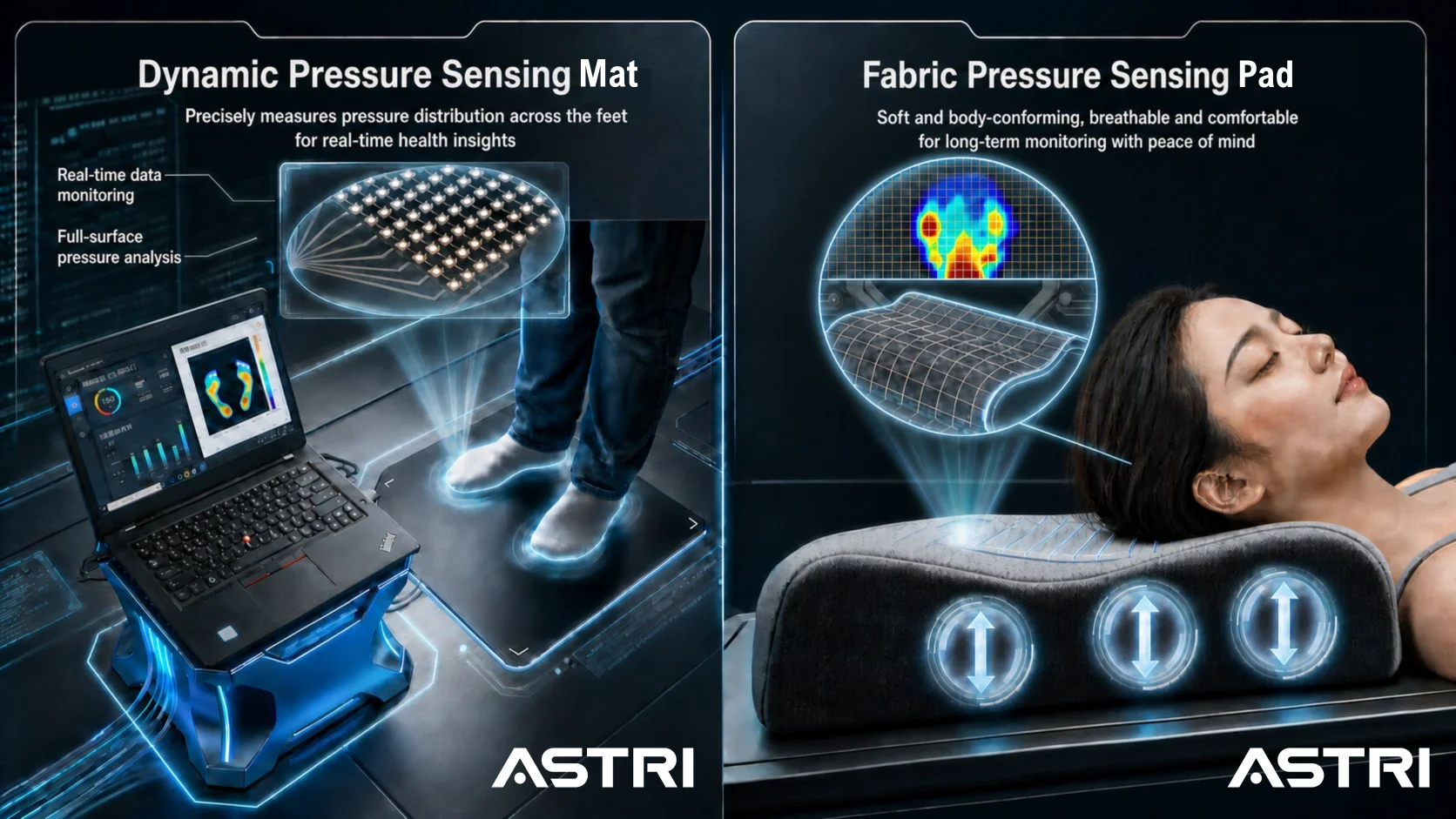
ASTRI has created two distinct types: thin-film sensors and textile sensors based on our proprietary pressure sensing materials. The thin-film version adopts facile low-cost screen-printing to layer pressure sensing materials onto flexible substrates, creating a high-density ultra-thin sensor mat that can detect forces ranging from a few grammes to several tonnes. The textile version integrates pressure sensing materials directly into fabric, maintaining all the comfort and breathability of ordinary cloth whilst adding smart sensing capabilities.
What makes these sensors truly remarkable is their versatility. The thin-film sensors can be assembled into "E-walkways" of any length, whilst the textile sensors can be woven into everyday items such as pillows, mattresses, and chairs.
Real-World Impact: From Hospital Floors to Bedrooms
These technologies are already making a tangible difference. In local hospitals and rehabilitation centres, ASTRI's E-walkways are helping clinicians analyse patients' gait and balance. Before knee surgery, doctors can assess whether a patient truly needs the operation. After surgery, they can track rehabilitation progress with precise, quantifiable evaluation, providing clear evidence of recovery and outcomes.
Beyond healthcare facilities, the textile-based sensors are transforming how we sleep and sit. Smart pillows and mattresses equipped with these sensors monitor the user’s body pressure distribution in real time, adjusting support dynamically to improve sleep quality and reduce discomfort. For people who spend long hours sitting, smart chairs can help prevent pressure-related health issues.
The potential extends far beyond these initial applications. As humanoid robots advance, they will need to feel and respond to touch—just as humans do. ASTRI's flexible sensors can serve as electronic skin, giving robots tactile perception and enabling safer, more intuitive human-robot interaction.
Recognition and What Lies Ahead
ASTRI's innovations have earned international acclaim, including the R&D 100 Awards, a gold medal at the International Exhibition of Inventions of Geneva, and the CES Innovation Awards. Yet the real measure of success lies not in trophies, but in impact.
By making invisible forces visible, these flexible pressure sensors are opening doors to personalised healthcare, enhanced comfort, and smarter technology. They represent a shift from one-size-fits-all solutions to adaptable, human-centric designs that work with our bodies rather than against them.
The future of sensing technology is not rigid—it is flexible. And it is already here.
Inquiries: corporate@astri.org