
As construction projects become larger, taller, and more complex, safety management is undergoing a fundamental transformation. Traditionally, safety has relied heavily on human experience, visual inspections, and periodic checks. But in an era of Modular Integrated Construction (MiC), digitalisation, and increasingly demanding project schedules, these approaches are no longer sufficient on their own.
The industry is now moving towards a more proactive model, one where risks can be identified, monitored, and even predicted before incidents occur. At the heart of this shift is the growing use of advanced sensing technologies, artificial intelligence (AI) and data platforms that provide real-time visibility into both construction operations and equipment health.
Enhancing Precision in Modular Construction
Consider the challenge of installing large MiC modules. Crane operators often need to position massive, prefabricated components with extreme precision despite limited visibility and tight tolerances. Even small deviations can result in repeated adjustments, project delays, or safety risks.
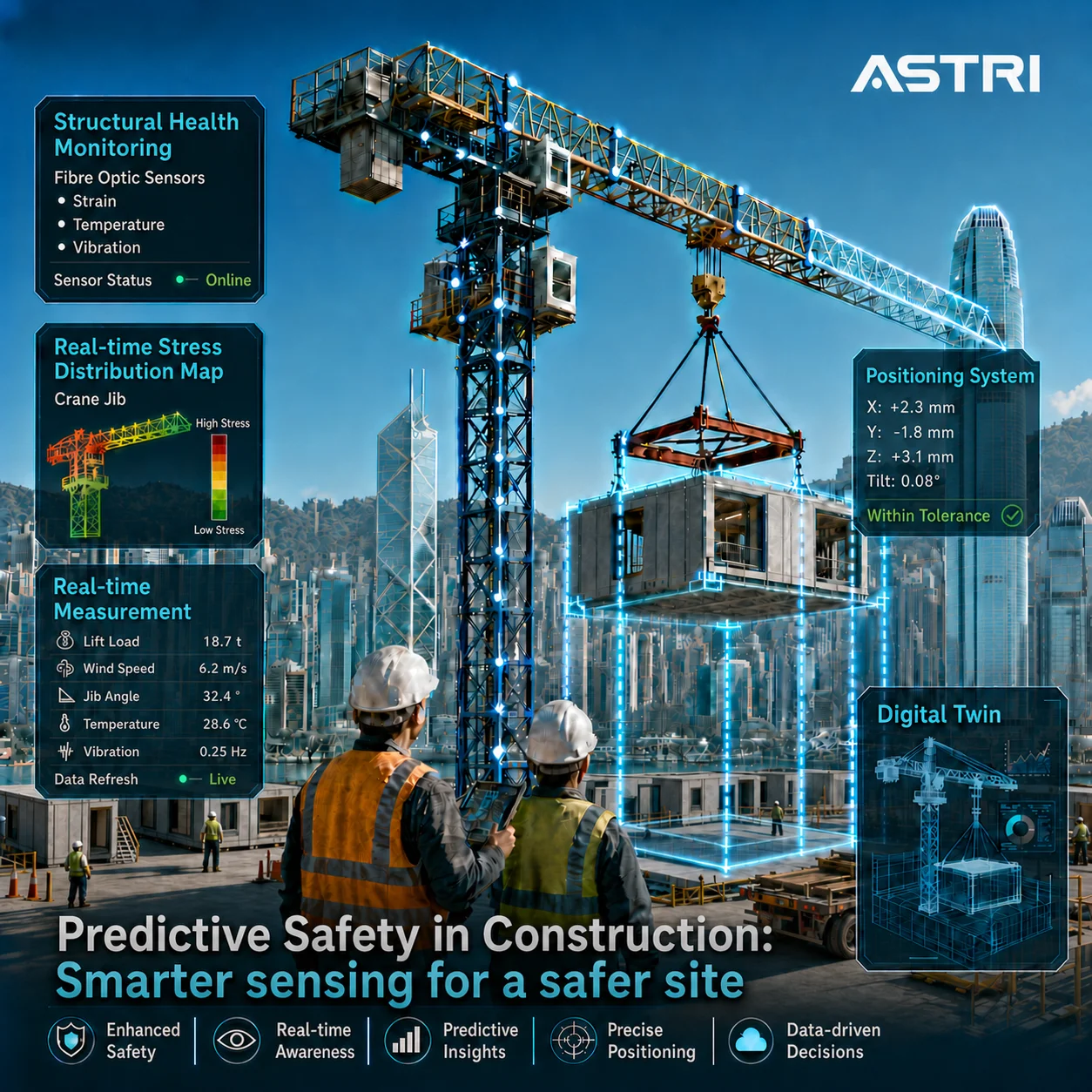
To address this challenge, ASTRI has developed a Smart Optics Precision Positioning System that combines optical sensing, neuromorphic technologies, and edge computing to provide real-time positioning and alignment information during lifting operations. AI-enabled analytics can further process sensor data to identify deviations, recognise abnormal movement patterns, and support timely interventions, enhancing situational awareness during complex hoisting activities.
Safety challenges, however, extend beyond what operators can see. Tower cranes are subjected to repeated stress over thousands of lifting cycles, and structural fatigue can accumulate gradually over time. Because these changes are often invisible, they may remain undetected between routine inspections.
To help close this gap, ASTRI's Photonics-Enabled Crane Structural Health Monitoring System uses Fiber Bragg Grating optical sensors to continuously monitor structural stress at critical locations. By providing engineers with quantitative insights into a crane's condition, such technologies offer the potential to identify issues earlier and support more informed maintenance decisions.
Turning Data into Foresight
The greater significance of these innovations lies not in the individual technologies themselves, but in the data they generate. Advanced AI algorithms can analyse large volumes of operational and structural data far more efficiently than traditional manual approaches, uncovering patterns that may otherwise go unnoticed.
When combined within a digital twin environment, operational and structural information can be analysed collectively to identify trends, optimise lifting procedures, detect anomalies, and estimate future maintenance requirements. AI models can further enhance these capabilities by continuously learning from historical and real-time data, improving the accuracy of risk assessments and enabling earlier warnings of potential failures or safety incidents. This creates opportunities to move beyond reactive responses towards predictive risk management.
Building the Future of Safer Construction
As the construction industry accelerates its digital transformation, the ability to see more clearly, measure more accurately, and anticipate potential risks is becoming a strategic advantage. The future of construction safety will not be defined solely by stronger equipment or stricter procedures, but by how effectively technologies are integrated into everyday decision-making.
Examples such as those being developed by ASTRI offer a glimpse of how AI-powered analytics, combined with intelligent sensing and photonics can help build safer, smarter, and more resilient construction sites.
Inquiries: corporate@astri.org